
Self-hosted Remote Nodes - What Are They, and Why Do They Exist?

Remote Nodes for Pangolin are a deployment option that combines the control and privacy of self-hosting with the reliability and convenience of cloud management. This hybrid approach gives you high availability and cloud features without the operational complexity.
How Remote Nodes Work
Remote Nodes split responsibilities between you and us:
You control the data plane: Your Pangolin node runs on your infrastructure, handling all tunnels, SSL termination, and traffic processing. Your data never leaves your servers.
We handle the control plane: Pangolin Cloud manages DNS coordination, certificate management, database operations, backups, monitoring, and the dashboard interface.
When you deploy a Remote Node, it connects back to Pangolin Cloud for coordination while keeping all traffic processing local to your infrastructure. This architecture enables powerful features like automatic failover between multiple nodes and seamless integration with our cloud points of presence.
Quick Installation Overview
Getting started with a Remote Node deployment is remarkably simple. The installation process looks nearly identical to a standard Pangolin install, with just a few additional configuration steps.
Key Benefits
High Availability by Default
Deploy multiple Remote Nodes across different regions or providers. If one goes down, traffic automatically fails over to healthy nodes. You can even configure failover to our cloud infrastructure during maintenance windows.
Reduced Operational Burden
No more database migrations, backup management, or complex monitoring setup. We handle the operational complexity in the cloud while you focus on your core business.
The cloud dashboard evolves rapidly with new features and improvements. Your Remote Nodes stay current automatically without manual intervention.
Global Load Balancing
Users automatically connect to the closest healthy node, with intelligent routing and failover between your self-hosted Remote Nodes and cloud points of presence.
Complete Data Control
Despite cloud coordination, all your traffic and sensitive data flows through your own servers. You maintain complete control over data transit and compliance requirements.
Because data flows through your servers, you don’t pay data costs on the cloud to route your traffic!
How It Differs from Regular Self-Hosted
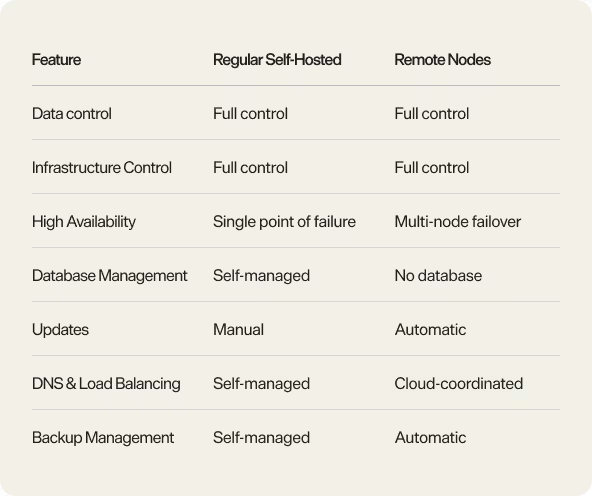
Perfect for Production Workloads
Remote Nodes are ideal for organizations that need:
- Enterprise reliability without enterprise complexity
- Data sovereignty with operational simplicity
- High availability across multiple regions
- Compliance requirements that mandate self-hosted infrastructure
- Reduced operational overhead while maintaining control
Ready to experience the best of both worlds? Get started with Remote Nodes in Pangolin today and see how enterprise-grade reliability doesn't have to mean giving up control.
Pangolin is an open-source infrastructure company that provides secure, zero trust remote access for teams of all sizes. Built to simplify user workflows and protect critical systems, Pangolin helps companies and individuals connect to their networks, applications, and devices safely without relying on traditional VPNs. With a focus on device security, usability, and transparency, Pangolin empowers organizations to manage access efficiently while keeping their infrastructure secure.
Keep reading
 Secure Remote Access: Enterprise ZTNA Implementation Guide
Traditional enterprise remote access methods like legacy VPNs often grant overly broad network visibility, creating severe vulnerabilities and lateral movement risks. This comprehensive guide covers how to transition your organization to an identity-driven, resource-level secure remote access model. Discover the five core pillars of a resilient Zero Trust architecture, compare modern ZTNA solutions, and follow our step-by-step framework to eliminate public internet exposure without disrupting employee workflows.
Guides GitOps Workflow for Pangolin Blueprints: Continuous Access Control via CI/CD
Stop policy drift and manual dashboard overhead. This guide details a GitOps workflow for Pangolin Blueprints, using declarative YAML state in Git and automated application via GitHub Actions. By treating Git as the source of truth for access intent, teams gain crucial operational benefits like version history, pull request review, and the ability to manage resources at scale
Guides IoT Device Provisioning at Scale with Golden Images for Edge Fleets
A practical way to provision IoT devices at scale: start with a golden image, keep bootstrap simple, let first boot handle setup, and use Pangolin sites and blueprints as one concrete model.
Guides